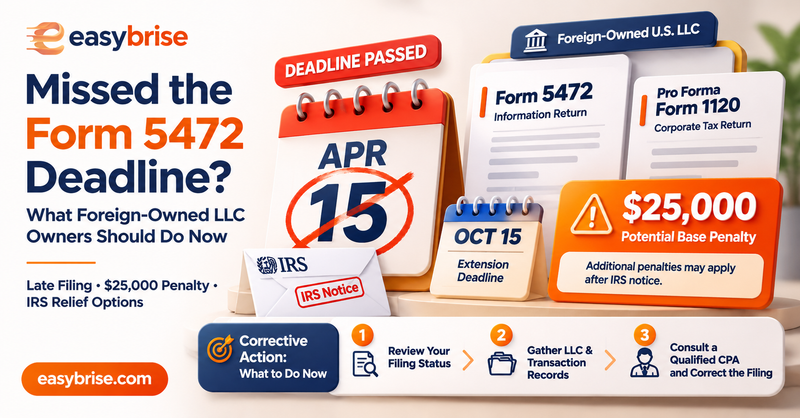
If you own a US LLC as a non-US resident and just realized you missed the Form 5472 deadline, take a breath. You're not the first, and it's often more fixable than people fear. What matters now is working out exactly where you stand and moving quickly, because the penalty clock doesn't wait. Below is how to figure out your situation, what you'll need and what to do over the next few weeks. This isn't tax advice, so have a licensed CPA review your case before you file anything.
Last reviewed: October 29, 2026.
Why This Is Urgent
Form 5472 is due April 15 for calendar-year LLCs. If you filed Form 7004 on time, the deadline moved to October 15. That date has now passed.
The IRS penalty for not filing, filing late or filing an incomplete return is $25,000 per form, per year. If the IRS sends a notice and 90 days go by without a correct filing, another $25,000 is added for every further 30-day period, with no cap. Two related parties and nothing filed means two penalties.
It doesn't matter whether your LLC owed any tax. This is an information return, and the penalty attaches to the missing information, not to a tax bill.
Did You Actually Have to File?
If your US LLC is a single-member LLC owned 100% by a non-US person, almost certainly yes. Zero income isn't the test. The trigger is a reportable transaction between the LLC and you or another related party, and the bar is low: putting money into the account, getting reimbursed for formation costs, taking a distribution, or lending money in either direction. Nearly every foreign-owned LLC has at least one of these in its first year.
Multi-member LLCs are a different case, with their own partnership filings.
What Counts as a Reportable Transaction
Founders often underestimate how much belongs on the form. Typical examples:
- Money you put into the LLC, including the first deposit that opened the bank account
- State filing fees, registered agent fees or software you paid personally for the LLC
- Money the LLC paid back to you for those costs
- Transfers from the LLC to you, whatever you call them
- Loans from you to the LLC, or from the LLC to you
- Services you or a related company provided to the LLC, or the other way round
If money or value moved between the LLC and you, assume it's relevant and let your CPA decide how to report it.
Where Do You Stand?
Find the situation that fits best.
1. You never filed anything
April 15 passed with no Form 7004 and no return. The failure has already happened for that year, and the exposure grows if an IRS notice arrives and goes unanswered. Gather your records and talk to a CPA about filing late and whether any relief applies.
2. You filed Form 7004, but didn't file by October 15
The extension only pushes the deadline to October 15. There's no extension for the extension, so treat the return as late from October 16 and file as soon as you can.
3. You filed, but the return may be incomplete
An incomplete return counts as a failure to file. The usual causes are:
- No "Foreign-owned U.S. DE" label on the pro forma Form 1120
- One combined Form 5472 covering several related parties, when each needs its own
- Non-cash items left off, like in-kind contributions or services exchanged
- Small transactions overlooked, such as paying the state filing fee from your personal account
Have your CPA compare what you sent with your real transactions.
4. You already got an IRS notice
The 90-day clock has started. Respond right away, don't wait for the next letter.
Not sure which one is you? Look for proof of what you sent. This return can't be e-filed, so you should have a mailing receipt or a fax confirmation. That usually settles whether you filed.
5. You missed more than one year
This is common when founders learn about Form 5472 a year or two after formation. Each missed year is its own failure, so each needs its own return. Pull together records for every year since formation before talking to your CPA, so they can see the whole picture at once rather than fixing one year at a time.
Late Filing and Relief: Stay Realistic
Two routes exist, and neither is automatic.
- Reasonable cause: the IRS can excuse the penalty if the failure wasn't willful neglect and you can document why it happened. Genuinely not knowing about a new requirement can sometimes support this, but it needs a written explanation.
- Delinquent international information return procedures: the IRS has a structured path for missed international information returns like this one.
Relief may be more realistic if you come forward before the IRS contacts you, but nothing is guaranteed, and it depends on facts a professional has to review. Don't rush out a half-complete return just to say you filed, because an incomplete one counts as another failure.
Mistakes to Avoid When Filing Late
- Filing in a panic. A rushed, incomplete return can count as another failure.
- Leaving out small items. A $100 state fee paid from your personal card is still a transaction.
- Filing only the latest year. If earlier years were missed too, they need attention as well.
- Ignoring IRS mail. A notice starts the 90-day clock whether you open it or not, so make sure your registered agent and mailing address forward everything promptly.
- Writing the explanation yourself without advice. A reasonable-cause statement is worth getting right the first time.
What to Gather Before You Call Your CPA
- Your EIN confirmation letter
- Your LLC formation documents
- Bank statements from the date of formation
- A list of every transaction between you and the LLC: contributions, loans, distributions, reimbursements and formation costs you paid personally
- Any IRS letters you've received
- Copies of anything you filed, including Form 7004, plus proof of mailing or faxing
- A list of all related parties
- The Reference ID Number you used, if you had no US tax ID
Keep these records. The IRS generally expects you to keep supporting documents for several years, and failing to keep the records Form 5472 relies on is a separate trigger for the same $25,000 penalty.
A Realistic Timeline
This is a suggested pace, not an IRS schedule. The only fixed clock is the 90 days after an IRS notice.
- This week: work out which situation you're in and gather your records.
- Within about two weeks: have a CPA review your case and decide the route: late filing, a corrected return or a relief procedure.
- As soon as you're ready: file by mail or fax, since this return can't be e-filed.
- If an IRS notice arrives: respond straight away.
- Going forward: put April 15 on your calendar, and file Form 7004 before that date if you need more time.
How to Stop This Happening Again
Most missed filings come from the same habit: money moving between you and the LLC isn't recorded as it happens. Keep a running log all year. Our guide to foreign-owned US LLC tax filing and the full Form 5472 guide explain what to track.
If you'd rather not carry the deadline yourself, EasyBrise's Tax & Compliance Pro plan is built for foreign-owned single-member LLCs. It's $1,499 a year and includes:
- Form 5472 and pro forma Form 1120 filing
- Tax extension filing, if required
- Filing deadline monitoring and reminder alerts
- IRS notice review and response assistance
- An annual CPA consultation
- A dedicated compliance manager
See how it works on our compliance page. If you're dealing with a missed past year, talk to the team first, and review your case with a tax professional before anything is filed.
Frequently Asked Questions
What happens if I missed the Form 5472 deadline?
The base penalty is $25,000 per form, per year. If the IRS sends a notice and you still haven't filed correctly within 90 days, another $25,000 applies for every further 30-day period, with no cap.
Can I still file Form 5472 late?
Yes, and sooner is better. The extra 30-day penalties only start after an IRS notice and 90 days, and they continue until the filing is made correctly. Have a CPA prepare it.
Can the $25,000 penalty be waived?
Sometimes. The IRS has reasonable-cause relief, but it needs a well-documented case and isn't automatic. Don't count on it.
I filed Form 7004. Does that cover me?
Only until October 15. The extension has to be requested by April 15, and there's no extension for the extension.
Can I e-file a late Form 5472?
No. For a foreign-owned single-member LLC, the pro forma Form 1120 and Form 5472 go to the IRS by mail or fax. Keep proof of whichever you use.
My LLC had no income. Do I still have a problem?
Possibly. The filing depends on transactions between you and the LLC, not on income. If you funded the account or paid any of its costs, a return was likely due.
If I'm exempt from BOI reporting, am I exempt from Form 5472?
No. They're separate requirements run by different agencies. BOI is handled by FinCEN, Form 5472 by the IRS. Our article on BOI for foreign-owned US LLCs explains that side.
Need Ongoing Help So You Don't Miss It Again?
Look at the Tax & Compliance Pro plan or see all pricing.
EasyBrise is a document filing service, not a law firm, bank or accounting firm. Tax filings are handled through licensed professionals where required. This article is general information, not tax or legal advice.