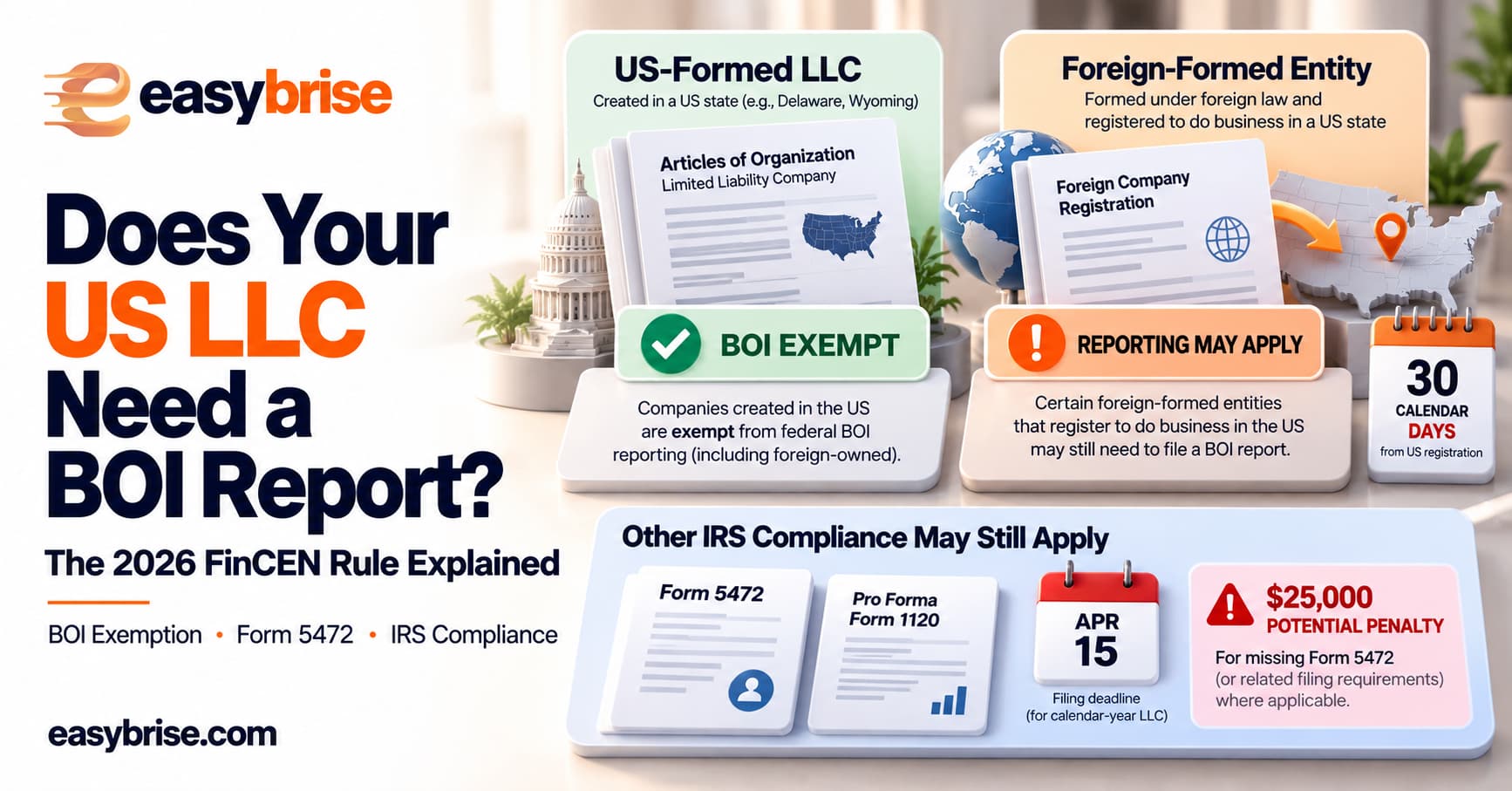
Short answer: no. If your LLC was formed in a US state, it's exempt from BOI reporting, even when every owner lives abroad. Our BOI guide tracks the rule as it stands. Below is what changed, what it means for you, how to check your own structure, and the filings that still apply.
Last reviewed: October 21, 2026.
What FinCEN Says Now
On August 11, 2026, FinCEN issued a final rule on beneficial ownership information (BOI) reporting. It took effect on August 14, 2026, and makes permanent the exemptions FinCEN introduced in March 2025. Under it:
- Companies created in the US are exempt and no longer have to file BOI reports.
- A reporting company doesn't need to report US persons as beneficial owners or company applicants.
- US persons don't have to provide BOI to a reporting company.
- US persons who already hold a FinCEN ID don't have to update or correct what they filed earlier.
- The term "reporting company" now covers only entities formed under foreign law that registered to do business in a US state.
How BOI Got Here: A Short Timeline
A lot of the confusion around BOI comes from how often the rules moved. If you read an older article that says every LLC must file, it was probably written before the changes below.
- 2021: The Corporate Transparency Act became law and created the BOI reporting requirement.
- January 1, 2024: Reporting started. At that point, most small US companies, including foreign-owned LLCs, were expected to file.
- Late 2024 to early 2025: Court challenges paused and restarted enforcement more than once, and deadlines shifted.
- March 2025: FinCEN issued an interim final rule exempting companies created in the US.
- August 2026: FinCEN's final rule made that exemption permanent, effective August 14, 2026.
That history is why you may still see paid "BOI filing" offers or outdated warnings online. They describe a rule that no longer applies to US-formed companies.
What This Means for a Foreign-Owned LLC
The exemption turns on where the company was formed, not who owns it. A Wyoming, Delaware, New Mexico or Texas LLC owned entirely by non-US residents is a US-formed company, so it has no BOI filing, no update obligation and no deadline.
If you filed a BOI report in the past, you don't need to keep updating it. Changes in ownership, address or members no longer trigger a federal BOI update for a US-formed company.
How to Check Whether Your Company Is US-Formed
Look at the document that created your company:
- US-formed: Your company was created by filing Articles of Organization (an LLC) or a Certificate of Incorporation (a corporation) with a US state, for example the Wyoming Secretary of State or the Delaware Division of Corporations. If EasyBrise formed your company, this is your situation.
- Foreign-formed: Your company was created under another country's law, for example as a UK limited company or an Indian private limited company, and later filed to register or qualify to do business in a US state.
One point often confuses founders. States also use the word "foreign" for a company from another US state. If your Wyoming LLC registers to do business in Texas, Texas calls it a "foreign LLC". For BOI purposes it is still a company created in the US, so it stays exempt. What matters is the country whose law created the company, not how a second state labels it.
Does This Apply to C-Corps and Multi-Member LLCs?
Yes. The exemption covers companies created by a filing with a US state, whatever their type. A Delaware C-Corp owned by founders abroad is exempt in the same way as a single-member Wyoming LLC. The number of members or shareholders doesn't change the answer, and neither does where they live.
When BOI Still Applies
The rule still reaches foreign-formed companies that register to do business in a US state. A UK limited company that registers in Wyoming, for example, is still a reporting company. It has 30 calendar days from the date its US registration takes effect to file.
So the question is how your company was created. If you formed an LLC through a US state filing, you're exempt. If a foreign company later registers in the US, that entity is a different case and needs its own review.
EasyBrise doesn't file BOI reports. Filing directly with FinCEN's own e-filing system is free.
What Still Applies to You
Dropping BOI doesn't clear your compliance calendar. A US single-member LLC that is 100% owned by a non-US person still has these:
- IRS reporting: Form 5472 with a pro forma Form 1120 every year, due April 15 for calendar-year filers. The penalty for missing it is $25,000 per form. Our Form 5472 guide covers who files.
- State obligations: the annual report and any franchise tax, depending on where you formed.
- Registered agent: it renews every year after the first year.
Banks and payment providers will also still ask who owns the company when you open an account. That comes from their own customer verification rules, not from BOI, so the BOI exemption doesn't change what a bank asks for. Expect to share passport details and ownership information during onboarding.
State Rules Are Separate
The federal exemption covers FinCEN's BOI reporting only. It doesn't override state law. A few states have looked at or adopted their own ownership disclosure rules, and those follow their own scope and timelines. If you formed or registered in a state with its own regime, check that state's current guidance separately.
Watch for Fake BOI Letters
FinCEN has warned about scams that use its name. There is no fee to file BOI with FinCEN, and FinCEN has no "Form 4022" or "Form 5102". If a letter asks for payment, a QR scan or personal ownership details, don't respond until you've verified the sender.
Foreign founders are frequent targets because their company details are public in state records and they may not know the current rule. A simple test: any message that says your US-formed LLC must pay to file BOI is wrong under the current rule.
Frequently Asked Questions
Does my foreign-owned US LLC need to file a BOI report in 2026?
No. A company created by a US state filing is exempt from BOI reporting. The exemption depends on where the company was formed, not on where its owners live.
I filed a BOI report earlier. Do I need to update it?
No. US-formed companies no longer have to file BOI reports, so there's nothing to update or correct. FinCEN also says US persons with a FinCEN ID don't need to update what they submitted before.
Which companies still have to file?
Entities formed under foreign law that registered to do business in a US state. They have 30 calendar days from the date their US registration takes effect. A UK limited company registering in Wyoming is one example.
My Wyoming LLC is registered as a "foreign LLC" in another state. Do I file?
No. "Foreign" in that sense only means the company comes from a different US state. It was still created in the US, so it remains exempt from BOI reporting.
Is a Delaware C-Corp owned by non-US founders exempt too?
Yes. The exemption applies to companies created by a US state filing, including corporations, regardless of where the owners live.
Is the exemption permanent?
FinCEN's final rule, effective August 14, 2026, makes the exemptions it first introduced in March 2025 permanent. BOI rules have changed several times in recent years, so we check FinCEN's guidance regularly and update this article if anything changes.
If I'm exempt from BOI, do I have any other filings?
Yes. A US single-member LLC that is 100% owned by a non-US person still files Form 5472 with a pro forma Form 1120 every year, even with zero revenue. You also have your state's annual report and any franchise tax. See our Form 5472 guide and our compliance service for how deadlines are tracked.
What to Do Now
- Confirm your company was formed by a filing with a US state, not registered as a foreign entity.
- Ignore paid BOI solicitations.
- Put your state and IRS deadlines on a calendar.
- Keep your formation documents handy for bank and payment provider checks.
Not sure where your structure lands? See our BOI guide or review your setup with a licensed professional.
This article is general information, not legal or tax advice. EasyBrise is a document filing service, not a law firm, bank or accounting firm. BOI rules have changed several times, so check FinCEN's current guidance before you rely on this.