Best Accounting Software for a Delaware C-Corp with International Founders (2026)
Oct 29, 2026
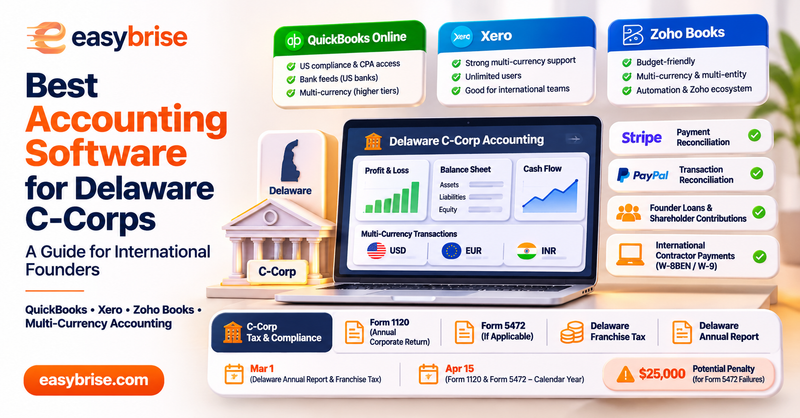
Setting up a Delaware C-Corp from outside the US is the easy part. The bookkeeping that follows is where most founders trip up. Investors want clean US-style financials, the IRS wants foreign-owner transactions tracked, and your Stripe payouts, bank feeds and founder loans all have to end up in the right place. Pick the wrong software on day one and you'll be untangling it a year later, usually the week before a funding call. So let's go through what actually matters and which tools fit.
What a C-Corp with Foreign Founders Actually Needs
A C-Corp pays tax as its own entity, at 21% federally, and files Form 1120 every year no matter where the owners live. Delaware adds an annual report and a franchise tax due March 1. And if foreign owners hold 25% or more, the company generally files Form 5472 with its return to report certain dealings with those owners. Miss it and the penalty starts at $25,000 per form. We've broken that down in our Form 5472 guide.
In practice, you want software that can do the following:
- Handle several currencies, so you can invoice a client in euros or pay a contractor in rupees without doing the maths by hand.
- Pull in feeds from your US bank, Stripe and PayPal.
- Let you tag founder loans, capital contributions and owner payments, since those are exactly what Form 5472 asks about.
- Produce accrual-based statements: profit and loss, balance sheet and cash flow.
- Give your CPA a login without charging for an extra seat.
- Keep receipts attached to the transactions they belong to.
Why a C-Corp's Books Are Different from an LLC's
If you've run a single-member LLC before, a C-Corp will feel stricter. An LLC owned by one person is usually treated as a disregarded entity for US tax purposes, so money moving between you and the company is fairly informal. A C-Corp is a separate taxpayer, and the line between you and the company has to stay sharp.
That changes a few everyday habits:
- You can't just "take money out". Money leaving the company to a founder has to be classified as salary, a dividend, a loan repayment or an expense reimbursement. Each one is treated differently for tax.
- Equity has its own accounts. Share capital, additional paid-in capital and retained earnings sit on the balance sheet and investors will read them closely.
- Loans need paper behind them. If a founder lends money to the company, record it as a loan with a short written agreement, not as random deposits.
- The company keeps its own tax year and return. The C-Corp's Form 1120 is separate from anything you file personally at home.
Good software makes these distinctions easy to record. Bad habits make them almost impossible to reconstruct later.
The Options, One by One
QuickBooks Online
Most US accountants already use it, so your CPA probably won't need any hand-holding. Bank feeds work well with American banks, and the categories map neatly to US tax forms. The downsides are that multi-currency only comes with the higher plans and the price keeps creeping up, so check what you'd really pay before you commit. It's the best pick if you want the widest pool of accountants to choose from.
Xero
Many people find Xero's interface simpler to learn. Multi-currency is a real strength, and every plan includes unlimited users, which helps if your team is spread across time zones. On the other hand, fewer US accountants know it, US payroll usually runs through a separate provider, and some currency features sit on the higher tiers. It suits founders who sell in several currencies.
Zoho Books
It costs less than the other two and still gives you multi-currency, multi-entity support and decent automation. It also plays well with the rest of the Zoho suite. The thinner spots are US tax integrations, and fewer US CPAs have worked with it, so ask yours before you sign up. A good fit for tight budgets or teams already living in Zoho.
Wave and FreshBooks are fine for a solo side business. Most funded C-Corps outgrow them quickly, because reporting and multi-entity options are limited.
Quick Comparison
| Software | Best for | Multi-currency | US accountant familiarity |
|---|---|---|---|
| QuickBooks Online | US compliance, CPA access | Higher-tier plans | Very high |
| Xero | Multi-currency, teams | Yes (tier-dependent) | Medium |
| Zoho Books | Budget, global teams | Yes | Lower |
Already know which country you’re forming from? Browse our step-by-step, country-specific formation guides.
Plans and prices change often, so check each vendor's site before you subscribe.
Setting Up Your Chart of Accounts
Whichever tool you choose, spend an hour on the chart of accounts before you connect any feeds. A few accounts matter more for a foreign-owned C-Corp than for a typical small business:
- Due to shareholder / due from shareholder. Use these for founder loans in either direction, so they're easy to pull out at tax time.
- Common stock and additional paid-in capital. Record the money founders paid for their shares here, not as revenue.
- Stripe or PayPal clearing account. Payouts land as one net amount, while sales and fees happen separately. A clearing account keeps them matched.
- Foreign exchange gain or loss. This catches the small differences that appear when invoices and payments are in different currencies.
- Contractor payments. Keep these apart from employee payroll, because they're reported differently.
Ask your CPA to review the chart once before you start. It's a short job for them and saves a messy clean-up later.
Recording Stripe Payouts Correctly
Stripe is where many founders' books first go wrong. Stripe pays out a net amount after fees and refunds, so if you record only the payout as revenue, your sales look smaller and your fees disappear. The cleaner approach is to record gross sales, record Stripe fees as an expense, and let the payout settle against the clearing account. QuickBooks, Xero and Zoho all have Stripe integrations or connectors that help with this. Check how each one treats fees and refunds before you rely on it. For setup questions on the Stripe side, see our guide to Stripe for non-resident founders.
Paying Contractors Abroad
Many founder-led C-Corps pay developers or designers outside the US. The paperwork differs from paying US contractors. A foreign contractor working outside the US typically gives you a Form W-8BEN instead of a W-9, while US contractors generally need a W-9 and may need a Form 1099-NEC at year end. Keep these forms attached to the contractor's record in your software, so your CPA can see who is who. If you pay contractors in their own currency, record the payment at the exchange rate on the day it went out.
What Investors Look for in Your Books
When a fund starts due diligence, it usually asks for monthly accrual-based financial statements, a clean cap table that matches the equity accounts, and an explanation of any large or unusual transactions. Founder loans with no documentation, revenue that mixes in capital contributions, and missing months are the issues that slow deals down. Closing the books every month, even roughly, puts you in a much stronger position than a year-end scramble.
Mistakes That Cost Founders Money
- Mixing personal and company spending. It's painful to untangle later and raises audit risk.
- Forgetting to record founder loans and contributions. These are the transactions Form 5472 cares about.
- Keeping cash-basis books while planning to raise money. Investors usually expect accrual.
- Ignoring currency gains and losses.
- Leaving receipts for later. Catch-up bookkeeping always costs more than staying current.
A Simple Year-End Checklist
- Reconcile every bank, card, Stripe and PayPal account to its statement.
- Confirm all founder loans, contributions and payments are tagged.
- Review foreign exchange gains and losses.
- Collect W-8BEN and W-9 forms for everyone you paid.
- Export the profit and loss, balance sheet and general ledger for your CPA.
- Put the Delaware franchise tax and annual report (March 1) and Form 1120 with any Form 5472 (generally April 15 for calendar-year companies) on your calendar.
Software Won't File Your Taxes
Accounting software records what happened. It doesn't file Form 1120, prepare Form 5472 or submit the Delaware annual report. Those need a tax professional and a calendar someone actually watches. Plenty of founders pay for good software and still miss a deadline. Our compliance support page explains how deadline tracking works. If you're still comparing structures, read LLC vs C-Corp for foreign founders and how a Delaware C-Corp works for foreigners.
How to Choose
Ask your accountant first. Their preference will save you hours every year. After that, match the tool to your situation. Invoicing in lots of currencies points to Xero. Wanting the biggest pool of US accountants points to QuickBooks. A tight budget points to Zoho Books. Whichever you pick, connect your US bank account from day one (Mercury or Relay are the usual choices, and our Mercury vs Relay comparison covers the differences), keep personal spending separate, and tag founder transactions as they happen.
Where EasyBrise Fits In
EasyBrise helps non-US founders form and run US companies, from the Delaware C-Corp filing and EIN to the paperwork that comes after. The tax and accounting support covers tax filing preparation, IRS correspondence, bookkeeping support and year-round deadline tracking. For C-Corps, the Tax & Compliance Elite plan is $2,499 a year and includes Form 1120 filing, a quarterly CPA review and a dedicated compliance manager. Monthly bookkeeping is available as an add-on from $99 to $399. Full details are on the pricing page.
Frequently Asked Questions
Do I need accounting software for a Delaware C-Corp?
In practice, yes. The IRS expects accurate records, and investors will ask for financial statements. Software is the simplest way to keep both in order.
QuickBooks or Xero for international founders?
QuickBooks suits founders who want the widest US accountant support. Xero suits those who work in many currencies or have a team in different countries.
Does accounting software handle Form 5472?
It helps you track the transactions that feed the form, but it doesn't prepare or file it. A tax professional does that.
Can I do the books myself, or do I need an accountant?
Early on, many founders handle day-to-day bookkeeping themselves. Tax returns and foreign-owner reporting are better left to a professional, since mistakes there are expensive.
Should my C-Corp use cash or accrual accounting?
If you plan to raise money, accrual is usually the better choice, because investors expect accrual-based statements. Your CPA can confirm which method fits your tax situation.
How should I record money I lend to my own company?
Record it as a loan from a shareholder, backed by a short written agreement, not as revenue or a casual deposit. These loans are among the transactions Form 5472 asks about.
How long do I need to keep my records?
The IRS generally expects at least three years, and some records, such as employment and asset documents, need longer. Cloud accounting software with attached receipts makes this easy.
Ready to Set Up Your US Company Properly?
This article is for general information only and is not tax, legal or accounting advice.